


Wealth Matters Newsletter - July 2025
An Eventful Second Quarter and More Market Rotation
Written by: Mark P. Bernier, CFA, Senior Vice President/Wealth Management Officer, Jonathan M. Williams, CFA, CFP®, Vice President/Trust Investment Manager, and Zachary S. Herigan, Trust Investment Specialist
Market Leadership Broadened as We Expected
We entered 2025 expecting a somewhat challenging investment environment, characterized by heightened volatility, geopolitical uncertainty and lofty valuations, especially for U.S. stocks, particularly large growth companies. A small group of seven stocks, that have become known as the Magnificent 7, accounted for the vast majority of the U.S. stock market’s advance during 2023-2024. With valuations stretched for this narrow group of stocks, and the fact that trees don’t grow to the sky, we anticipated a broadening out of market participation beyond the Magnificent 7, and positioned portfolios accordingly.
Our expectations have been exceeded on all fronts. In a year defined by geopolitical uncertainty and shifting economic dynamics, we have seen broadening strength for U.S. equities to include large value stocks, mid-sized companies, and more recently small capitalization stocks as well. Perhaps the most surprising development that has quietly altered the global investment landscape has been the persistent weakening of the U.S. dollar, leading to outperformance for non-U.S. equity markets, most dramatically, European stocks.
Is The Dollar Losing its Edge?
After a period of strength driven by rising interest rates and safe-haven demand, the U.S. dollar has begun to lose momentum. Through the first 6 months of 2025, the dollar index has declined over 10%. We have to go all the way back to the early 1970s when President Nixon suspended the dollar’s convertibility to gold and the collapse of the Bretton Woods System to find worse dollar performance.
Despite holding the line on lowering short term interest rates thus far, investors expect the Federal Reserve to cut the fed funds rate twice by the end of 2025. Inflationary pressures have eased and the U.S. economy is showing some signs of weakness, with the manufacturing sector declining and the services sector showing modest gains, but at a declining pace. President Trump’s tariff-led trade policies have created widespread uncertainty, slumping consumer confidence, leading to downward pressure on the greenback. At the same time, global central banks, particularly in Europe, are showing greater resilience, supporting their currencies through rate cuts.
The Euro, in particular, has appreciated notably against the dollar, rising more than 13.5% since the beginning of the year. This is due not only to diverging monetary policy expectations, but also improving fundamentals acrosskey Eurozone economies. Inflation appears under control, consumer confidence is rebounding, and growth, while modest, is proving more resilient than expected. Additionally, Eurozone countries have committed to increase defense spending in response to the ongoing Russia-Ukraine conflict and President Trump’s pointed messaging on U.S. defense support in the region. This has attracted global capital and propelled a broader economic and industrial transformation, which in turn has ignited Europe’s financial companies, its largest sector.
Interest Rates and Currency Relationships
The European Central Bank (ECB) began cutting short term interest rates in June of 2024 for a total of 200bps, meanwhile the Fed initiated its first rate cut in September 2024 and has lowered the fed funds rate only 100bps thus far. The current spread between the rates is about 225bp. The outlook for ECB is perhaps one additional cut, while the Fed seems poised to cut twice through the end of 2025. Differences in interest rates across the global economy are the primary factor in the demand for one currency over another. What do these changes in relative currency demand (strength vs. weakness) mean for investors?
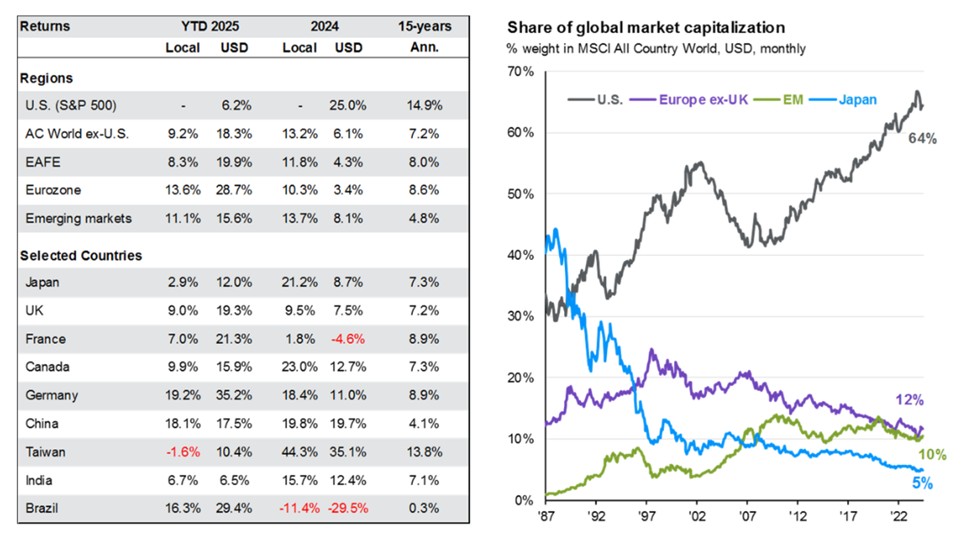
When the dollar weakens, returns on foreign investments can be amplified for U.S.-based investors. Here’s why: foreign earnings, when converted back into dollars, are worth more. The table on the left (below) depicts the impact that dollar weakness has had on market returns based in local currency vs the dollar.
Source: J.P. Morgan Asset Management, Guide to the Markets 3Q 2025
Driven by strong relative performance of U.S. stocks relative to the rest of the world for the past many years, the percentage share of market valuation has never been so high (Right chart, above). U.S. stocks peaked at nearly 70% of global market capitalization, but opportunities beyond U.S. markets offer important risk-reducing diversification benefits. Perhaps most importantly, international stocks offer a more compelling value opportunity than their U.S. counterparts.
International Markets: Attractive Valuations and Currency Tailwinds
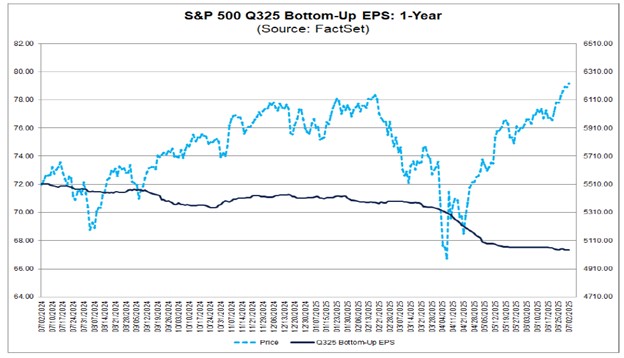
Beyond currency effects, many non-U.S. markets—particularly in Europe and parts of Asia—remain attractively valued compared to U.S. equities. Despite trailing international stocks year to date, U.S. stocks have seen a dramatic run-up, particularly in the tech-heavy NASDAQ. For a brief period of time, triggered by President Trump’s now infamous Liberation Day announcement that he would levy much higher-than-expected tariffs, markets sharply corrected, making valuations more appealing. The correction reversed just as sharply as it had fallen when Trump paused the implementation of tariffs for 90 days. The rally propelled major U.S. indices to all-time highs. However, third quarter earnings expectations have declined, taking us back to the same valuation dilemma we faced pre-Liberation Day.
Source: FactSet Research Systems, Inc.
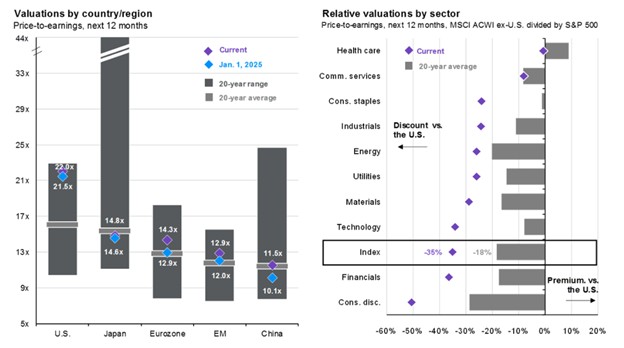
Meanwhile, many foreign markets have lagged, creating compelling valuation gaps. All of this points to further declines in the value of the dollar relative to the euro, which seems to indicate greater attractiveness for European stocks, which are trading at much lower multiples than U.S. stocks (see chart below).
Source: J.P. Morgan Asset Management, Guide to the Markets 3Q 2025
Consider the MSCI EAFE Index (which tracks developed markets outside North America). It trades at a meaningful discount to the S&P 500 in terms of forward price-to-earnings (P/E) ratios. For investors seeking exposure to quality companies at more reasonable prices with the bonus of potential currency gains, international markets warrant a closer look.
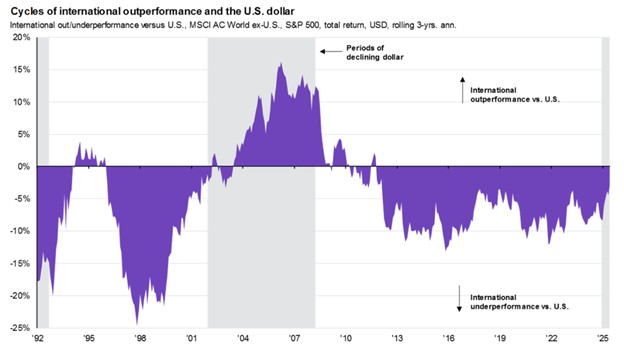
Currently, U.S. stocks are trading at historically high valuations as measured by P/E ratios; these stocks are essentially priced for perfection. If earnings fail to meet lofty expectations, individual stocks are likely to see sharp declines. European stocks are more reasonably valued, so downside risks are not as pronounced. Historically, when international stocks outperform U.S. stocks, the persistence of outperformance typically lasts for some duration of time. The most recent period of time is depicted in the chart below.
Source: J.P. Morgan Asset Management, Guide to the Markets 3Q 2025
Final Thoughts
For long-term investors seeking diversification and enhanced return potential, the world outside the U.S. looks increasingly compelling. The weakening U.S. dollar represents more than a macroeconomic footnote; it’s a potential tailwind for international equities. Coupled with attractive valuations and improving fundamentals abroad, we see an opportunity to rebalance portfolios with a greater global orientation.
Read other issues of our Wealth Matters newsletter.
Invest with us. Invest with experience.
Not FDIC-Insured - May Lose Value - Not a Deposit - Not Bank Guaranteed - Not Insured By Any Federal Government Entity.
Contact Us

CONTACT ONLINE
Complete the Wealth Management Contact Form to get started right away.

Contact a Team Member
We have dedicated staff that can assist you with applying right over the phone!
Call to get started now!

VISIT AN OFFICE
Our friendly, knowledgeable office staff can take your application at an office convenient to you.
Use our office locator to find an office near you.