


Wealth Matters Newsletter - January 2026
Thoughts On The Year Ahead
Written by: Mark P. Bernier, CFA, Senior Vice President/Wealth Management Officer Jonathan M. Williams, CFA, CFP®, Vice President/Trust Investment Manager Zachary S. Herigan, Trust Investment Analyst
Like the ending weeks in 2024, equity markets seemed to pump the brakes near the end of 2025, casting perhaps a cautionary pall over the beginning of the new year. Nevertheless, equity returns were strong across the board in 2025, with international stocks, benefitting from the tailwinds provided by the weakest single year performance of the U.S. dollar since 1973, leading the way for the first time since 2017. With the final numbers in, emerging market equities were the best performing asset class of 2025, providing a solid 34.4% return, followed by international developed market equities finishing the year with a 31.9% return. U.S. large cap growth stocks led domestic equities with a 17.9% return. On the whole, virtually every major traditional asset class finished in positive territory last year.
Indeed, one of the main investment themes that played out in 2025 was a broadening out of investment strength beyond the small group of stocks that have become known as the “Magnificent 7”. As seen in the chart below, the Magnificent 7 share of S&P 500 returns has been steadily declining from ’23 through ’25, which is a theme that we expect to continue through 2026, as investors seek more reasonably valued investments beyond these seven market leaders that have become synonymous with artificial intelligence.

While final economic growth numbers (GDP) won’t be released until after this newsletter has been published, real GDP is estimated to have grown around 2.0% for 2025, finishing at the low end of our 2.0% to 3.0% estimated range. The first quarter of 2025 saw negative real GDP growth due to surging imports as a result of companies front-running anticipated widespread tariffs. However, Q2 and Q3 rebounded in strong fashion, up 3.8% and 4.3%, respectively. At the time of this writing, Atlanta Fed GDPNow estimates the real GDP growth rate in the fourth quarter of 2025 to be about 5.1%.
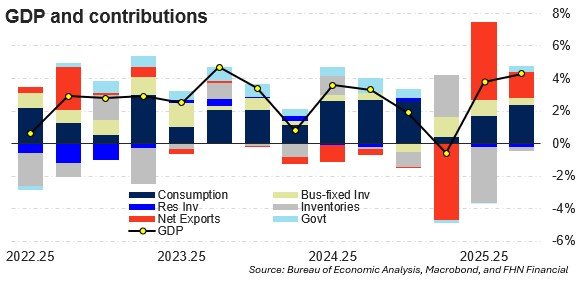
A resilient consumer and outsized capital expenditures, primarily in the form of AI-related investment, drove consumption and we expect more of the same to drive the economy in 2026. Additionally, CPI and PCE inflation that ran persistently near 3.0% is likely to moderate in 2026, toward a 2.5% reading, and there currently appears to be a very low probability of recession in 2026.
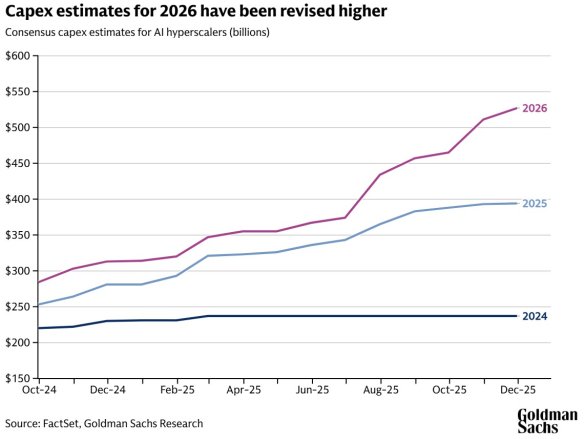
Spending on Artificial Intelligence, technological innovation, and productivity gains continue to underpin general optimism for global equities. Wall Street consensus estimates indicated that AI hyperscalers will spend $527 billion in capital expenditures related to AI in 2026; at some point, tangible return on these massive expenditures will need to flow through to the bottom line to support extended valuations in these names, and the jury is out as to whether that proof will become apparent as early as 2026. Winners and losers will ultimately be known only after the passage of time.
Growth Opportunities Continue to Evolve
We are neither overly cautious nor blindly optimistic in our view for 2026. We continue to believe that earnings growth, the primary long-term determinant of equity returns, is again achievable in 2026, and is particularly achievable for companies with durable competitive advantages. While 2025 was heavily influenced by the AI megatrend and a reshaping of global trade positioning, 2026 may be driven by the developing evolution of AI as the primary growth engine for the economy and markets through clear evidence of productivity improvements and proof of revenue gains attributable to AI. In other words, investors will eventually look for proof of return on investment. We see the opportunity set for such gains to be evidenced across the broad markets.
We reiterate our call to maintain diversified portfolios and find international equities, especially in large cap value, to be particularly attractive primarily due to their valuation compared to large U.S. companies, as well as the expectation for continued weakening of the U.S. dollar in 2026, which would continue to provide a tailwind for U.S. investors in foreign stocks. Additionally, we find U.S. small cap equities to be attractive following three consecutive Fed cuts to end 2025, as well as another one to two cuts expected in 2026.
Like last year, we expect returns from fixed income to be attractive, with the estimated yield on the Bloomberg Aggregate bond index currently around 4.3%; unless yields in the intermediate portion of the curve increase, we expect bonds to provide a stable source of returns, potentially enhanced by a diversified equity allocation.
Managing Macro and Market Risks
Inflation trends, monetary policy shifts, and geopolitical uncertainty remain key risks heading into 2026. The mid-term elections in the U.S. are likely to provide investors with another source of volatility during the year; market volatility should be expected rather than feared, creating opportunities for disciplined, long-term investors.
As always, investment portfolios should be positioned with a thoughtful blend of investments aligned with the most opportunistic growth potential, with steady durable growth attributes, leaning into the relative attractiveness of international equities, and the steadiness of fixed income components. Within all of the building blocks of our investment portfolios, we gravitate to investment vehicles with well-articulated investment strategies, that are repeatable, and focus on cashflow generation, with an eye toward downside protection. We believe thoughtful portfolio construction applied through a consistent, long-term asset allocation strategy aligned with each client’s long-term goals and objectives is the appropriate strategy to achieving investment success.
As we have continuously promoted in previous newsletters, we can’t stress enough how important it is to stay invested, and 2025 provided an excellent example as to why. In early April, the S&P 500 was down approximately 19% following the announcement of reciprocal tariffs by the Trump Administration, and the index finished the year up over 16%. As an investor, it is important to expect volatility, and not allow short-term market movements to derail your long-term goals.

Final Thoughts
One of the biggest stories to unfold in the New Year will be the succession of Federal Reserve Chair Jerome Powell when his term as the head of the U.S. central bank ends in May. President Trump has alluded he has narrowed down his candidates to just a few names such as Kevin Hassett, Director of the National Economic Council, and Kevin Warsh, former Fed Governor. The selection of the next Fed Chair will have wide-ranging implications for the future path of interest rates in the U.S. and many are concerned that the independence of the Fed will be threatened by the President’s desire to appoint a Fed Chair aligned with his agenda. This comes at a time in which the Fed is the most divided it’s been in years, as three dissenting votes were cast at the most recent Federal Open Market Committee meeting in December; two voting for no rate change, and one member dissenting in favor of a larger cut than the 25-bps cut that resulted from the meeting. Interest rates are a primary driver of economies and financial markets, and we will be keeping a watchful eye on developments at the Fed in 2026.
Read other issues of our Wealth Matters newsletter.
Invest with us. Invest with experience.
Not FDIC-Insured - May Lose Value - Not a Deposit - Not Bank Guaranteed - Not Insured By Any Federal Government Entity.
Contact Us

CONTACT ONLINE
Complete the Wealth Management Contact Form to get started right away.

Contact a Team Member
We have dedicated staff that can assist you with applying right over the phone!
Call to get started now!

VISIT AN OFFICE
Our friendly, knowledgeable office staff can take your application at an office convenient to you.
Use our office locator to find an office near you.