


Wealth Matters Newsletter - April 2026
Navigating Uncertain Markets
Written by: Mark P. Bernier, CFA, Senior Vice President/Wealth Management Officer, Jonathan M. Williams, CFA, CFP®, Vice President/Trust Investment Manager, Zachary S. Herigan, Trust Portfolio Manager
Through the first quarter of 2026 and into early April, the markets continue to navigate a complex transition: a late cycle economy now facing yet another exogenous geopolitical shock. The Iran conflict has introduced renewed inflation pressures via energy, constraining central banks and raising stagflation risks.
While near-term risks are elevated, long-term market drivers such as innovation, earnings growth, and capital formation remain largely intact. The key for investors is to balance the desire of seeking defensive positioning, with participation in long-term upside opportunities. For now, we believe the best path forward is for clients to remain committed to their long-term asset allocation strategy developed for them through our counsel, that anticipates varied market environments, including the current shock. We further encourage clients to seek our guidance when considering reducing portfolio risk during such challenging environments, since often, the best course of action in the long-term is to stay invested and to ride out the short-term volatility in a disciplined manner. We do not advocate market timing as a way to navigate market volatility.
Iran Conflict Complicates the Fed’s Dual Mandate
The war in Iran is impacting the global economy primarily through the elevated price of oil. Higher crude oil prices essentially manifest in broadly higher input costs that are passed along to consumers, which acts like an added tax on finished products. This pressures consumers, weakening demand and elevating uncertainty, resulting in tighter overall financial conditions. The longer the conflict lasts, the more impactful this becomes. However, regardless of the current geopolitical environment, time has consistently proven that markets will recover (see chart below).

Prior to the breakout of the conflict, global markets were widely anticipating a “soft-landing” scenario featuring easing monetary policy, a continuation of modest if not modestly accelerating economic growth, and a broad continuation of accelerating earnings growth across most market segments: regional (international and domestic stocks), style (growth and value), and size (small, mid, and large capitalization stocks). While we believe this long-term outlook remains intact, the short-term impacts are already being observed as prices at the pump are increasing. The U.S. is in a superior position to absorb the impacts of this conflict relative Europe and Asia as these countries are heavily reliant on oil imports from the Middle East, whereas the U.S. is a net exporter of oil.
Inflationary pressures and expectations are reaccelerating largely due to the global oil supply shock as the Strait of Hormuz has been effectively closed since the start of the Iran conflict over a month ago. It is estimated that about 20% of global crude oil supply flows through this narrow body of water.
Policy rates remain restrictive, with rate cuts no longer expected this year. At the beginning of 2026, it was widely anticipated that the Federal Reserve would lower short term interest rates two times. However, the global oil shock has ignited concerns that inflation will accelerate, and bond yields have been adjusting upwards accordingly. With this, the odds of rate hikes – rather than cuts – have been creeping up.
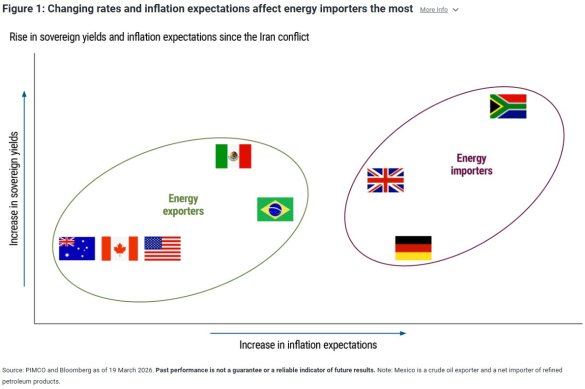
The reignition of inflation expectations places the Fed in a tough spot due to its dual mandate of price stability and full employment. The jobs market in the U.S. has been following the same theme for nearly a year now – “low hire, low fire”. Jobs growth has been slow to non-existent, especially in industries outside of healthcare and education.
If the Fed were to hike rates to combat rising inflation, then the other side of the mandate is threatened as higher rates would certainly impact the labor market, most likely reducing hiring and job openings even more so. Interest rates futures may be pricing in increasing odds of rate hikes this year, ho ever, the Fed is likely to follow the traditional central bank playbook during energy shocks: look through short-term developments and hold rates steady. Therefore, the current expectation is that interest rates will remain higher for longer, with volatility tied increasingly to inflation data releases and global oil prices, rather than the expectation of a clear easing (or hiking) cycle.

Equity Market: Don’t Forget About AI
With constant headlines following the events unfolding in the Middle East, the first quarter of 2026 has seemed as if the ongoing megatrend in artificial intelligence has become old news. However, AI has not gone anywhere, and some of the largest companies in the world, known as the “hyperscalers” have shown no signs of slowing their plans of increasing capital expenditures to build out data centers in monumental proportions (see chart below).

However, large growth stocks – made up of the likes of the hyperscalers – in the U.S. have been the biggest laggard year-to-date when referring to style box returns, down about 9 percent. Software stocks in particular experienced heavy sell-offs during the first quarter, with the iShares Expanded Tech – Software Sector ETF (IGV) down 24 percent year-to- date. Investors have been concerned by new AI coding capabilities released by OpenAI and Anthropic and that these models will essentially make software-as-a-service (SaaS) companies obsolete. This fear has been labeled as overblown by many analysts due to the fact that these companies are so deeply embedded into enterprises that switching, or developing in-house software, simply isn’t realistic – at least in the short-term. Regardless, U.S. large cap growth stocks had been running at historically elevated valuations prior to this year, and we see this short-term dip in their collective stock prices as welcomed.
Final Thoughts
Warren Buffett describes the primary driver of financial markets as a voting machine in the short-term, driven by investors’ collective market sentiment — if sentiment is widely more pessimistic than optimistic, prices fall. Over the longer-term, the markets function like weighing machines, with earnings and fundamental factors, along with productivity gains, influencing the direction of the markets. Short-term price volatility can be particularly noticeable during the interim period between quarterly corporate earnings releases, as traders (and algorithms) revert to evaluating macroeconomic conditions and headlines.
Our guidance is always dictated by a personalized approach with each of our clients, grounded in our mutual understanding of their unique ability and willingness to accept risk when contemplated over each client’s investment horizon.
We believe the most successful long-term investment approach is to maintain well diversified portfolios, to remain committed to an asset allocation strategy that reflects each client’s assessment of investment risk, and the patience necessary to benefit from the long-term upward bias of broad-based equity markets.
Read other issues of our Wealth Matters newsletter.
Invest with us. Invest with experience.
Not FDIC-Insured - May Lose Value - Not a Deposit - Not Bank Guaranteed - Not Insured By Any Federal Government Entity.
Contact Us

CONTACT ONLINE
Complete the Wealth Management Contact Form to get started right away.

Contact a Team Member
We have dedicated staff that can assist you with applying right over the phone!
Call to get started now!

VISIT AN OFFICE
Our friendly, knowledgeable office staff can take your application at an office convenient to you.
Use our office locator to find an office near you.